Canada Travel Guide
Canada Travel Guide

Canada Travel Guide

Alberta British Columbia Manitoba Newbrunswick Newfoundland and Labrador Northwest Territories Nova Scotia Nunavut Ontario Prince Edward Island Quebec Saskatchewan Yukon
Canada’s immense size precludes any hope of an accurate, general definition. In both geographic and cultural terms, for every definition, there arises an exception. For many, it is a place of unrelenting snow and ice, for others it is associated with warm days and pine forests; for some, it is defined by its vibrant cities, teaming with ethnically diverse populations and exciting entertainment, while for others it is a place of wilderness retreat, where it is still possible to be alone on a lake. Canada is all these things, and many more: a wonderful and inspiring land from sea to sea.

Canadian culture has historically been influenced by a mix of British, French, and Aboriginal cultures, but its American neighbours are of huge importance, and its absorption of people from all over the world, make it difficult to pinhole. While rural Quebec may speak 90% French, a suburb in Vancouver can have a population that is 40% Chinese.

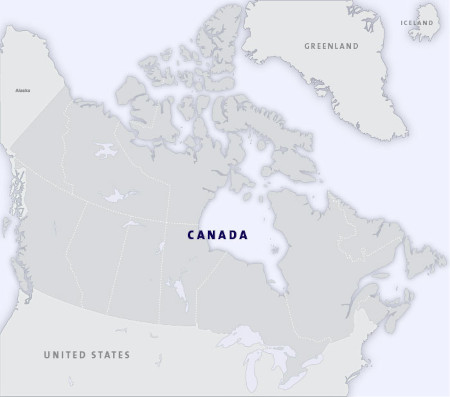
Native habitation has existed in Canada for about 10,000 years. Officially, the country was first explored by Europeans in the 15th century, but there is evidence of Norse contact in present day Newfoundland from as early as the 10th century. The present day population of about 32 million is unevenly spread across the immense landmass of 9,984,670 square kilometers. The distance from St. John’s on the east coast to Victoria on the west is a mind-numbing 7,800 km.

On the eastern seaboard, the ‘Atlantic Provinces’ of Newfoundland/Labrador, Nova Scotia, New Brunswick and Prince Edward Island, were traditionally defined by their fishing culture. The Grand Banks, the most productive fishery the world has ever known, sits off shore. Today these provinces have more diversified economies and draw tourists by their stunning natural beauty, and unique cultural offerings that are unlike anything else in Canada or in fact the world.

To the west, is the largest province in Canada, Quebec. Stretching from the rocky, lake strewn, and nearly uninhabitable lands to the north and the Arctic Sea, to the vibrant, historically and artistically important cities of Quebec and Montreal, the province of Quebec is not only large in size, but has a huge influence on defining Canada to itself, and the world. In rural areas, the French language is almost always used. In the cities, business is often undertaken in English, while the broader cultural experience is definitively French.

Ontario is the most populated province in the country and the most important in economic terms. It also holds Canada’s capital city, Ottawa and the Parliament. From potatoes to steel, for centuries it has been the economic centre of Canada, with numerous cities lining every one of the Great Lakes and with lands stretching south, well below the 49th Parallel (the traditional border between Canada and the US). The greater area of Toronto, the economic centre of the country and home to the Toronto stock exchange, has a population of over 5 million people, making it by far the biggest centre in the country, offering spectacular events, venues, festivals, dining, and entertainment experiences. Through a series of locks, the St. Lawrence River and Seaway connects the Atlantic Ocean to the Great Lakes, and the industrial centre of the country.

To the west, the ancient rock of the Canadian Shield gives way to the mythic prairies and the central provinces of Manitoba, and Saskatchewan. The land is known for beautiful fields of grain swaying in warm summer breezes, thunderstorms, huge reserves of fresh water and intense winters; the population is known for its ‘prairie hospitality’ where people tend to look after their neighbours. The main cities of Winnipeg and Regina also have thriving arts scenes.

The western provinces of Alberta and British Columbia are removed from central Canada not only by thousands of kilometers, but by different ways of thinking and ways of life. Alberta, once defined by agriculture and cattle, has also grown in importance each decade through its huge reserves of fossil fuels. Its capital city of Edmonton, along with Calgary, go through periods of incredible expansion, while its work force, wealth and confidence grow. Holding most of Canada’s sublimely beautiful National Parks in the Rocky Mountains, Alberta is also known for its outdoor recreation such as skiing, snow-shoeing and hiking. The famous National Parks around the resort towns of Banff and Jasper draw millions of tourists every year, and are known for their stunning mountainous surroundings.

British Columbia sits on the ‘other side’ of the Rockies. It is 80% mountainous, with one range following the next, and is greatly influenced by moisture coming off the Northeast Pacific. Climates shifts from one region to another are legendary, with travelers moving from rainforests to desert lands within a few hours drive. In the far north the largest non-polar glaciers start their migration west, and in the south, the ‘breadbasket’ of BC, the broad fertile Fraser Valley supports everything from cranberries to dairy farms. The central plateau is known for its open grasslands, forests and a myriad of lakes.

Greater Vancouver has a population of over 2 million, and with its excellent harbour bordered by mountains it is one of the world’s most beautiful cities, hosting world-renowned ballet, theatre and symphony performances, art galleries, museums, concert halls and stadiums. Victoria, the capital city of BC, sits at the south end of the largest island on the west coast of the Americas – Vancouver Island.

As if ten provinces were not enough, Canada also holds three ‘territories’, a designation of autonomy from the federal government that is somewhat different than a province. Recently created Nunavut is home to the Inuit people, with lands stretching from the Manitoba boarder to the North Pole. The Northwest Territories and Yukon are further west. Together, these polar and sub-polar regions of Canada are not only places of energy and mineral wealth, but are immensely beautiful. Their Boreal forests store 22% of the carbon on earth’s land surface, and are of great importance in balancing the world’s climate.

Canada has been a popular tourist destination for many years. By the sea or in the mountains, on a ranch or in the centre of the city, Canada offers a huge selection of accommodation. Whether you are traveling as a family, a honeymoon couple, an adventurer or a corporate executive, Canada-travel.ca provides you with a wide range of accommodations including hotels, resorts, vacation rentals, bed & breakfasts (B&B), guest ranches, cabins and provincial or private campgrounds. The Canadian landscape is as diverse as its culture. Check in, and start to explore.
Canadian Provinces and Territories:
Alberta British Columbia Manitoba New Brunswick Newfoundland and Labrador Northwest Territories Nova Scotia Nunavut Ontario Prince Edward Island Quebec Saskatchewan Yukon